
Sportomatic 911T Restored, Part 1


This article was originally written in November, 2020 by contributor Kevin McCauley.
“The Sportomatic isn’t an automatic in any sense of the word, because it doesn’t actually shift gears for itself.” Jordan Remeljej clears up my first misconception about the Sporto before we even set off.
Between our seats, a tall and familiar gear-shifter rises up, with some unusual markings on the knob: P, R, L, D, D3, and D4.

Remeljej is an Australian expat with a Daniel Ricciardo grin. He owns and operates Modern Aircooled, a Porsche shop in Houston, Texas, and greets me with an enthusiastic “g’day!,” when I arrive to inspect the Irish Green 1969 Porsche 911T that he’s been restoring.
Sportomatic, a portmanteau of “sports” and “automatic” (despite neither being true), was Porsche’s first attempt at offering a semi-automated transmission in a 911. Predicated by an idea that American’s were opting for automatics in record numbers by that stage, Porsche felt a ‘clutchless’ option was necessary. The bones are related to the manual 901 gearbox, but it behaves differently from nearly every other transmission on earth.
The H-pattern gear shifter looks like the one in a manual 911, but put one hand to the shift knob, it depresses slightly, triggering a microswitch signal that opens a pneumatic valve, which releases the vacuum-operated clutch. With the clutch disengaged, the driver is free to change gears. Releasing the knob then reengages the clutch, and forward drive resumes.

A torque converter – found in a typical automatic – acts as a flywheel to the clutch, which serves as almost a shock absorber to the driveline, and allows the car to stop in each of the four forward gears without stalling. The torque converter effectively multiplies torque from a standstill, allowing the smaller 2-liter engine to push the car off from a dead stop in any gear.
In theory, it’s a manual gearbox – without a clutch pedal – that can never stall. When it was released in 1968, this was the manual transmission of the future, in the same way that Dippin’ Dots are the ice cream of the future.

Remeljej very matter-of-fact when he talks about how this car sat in Dallas, non-running for a decade, before its current owner bought it and brought it to him. But he lights up whenever the oddball transmission comes up.
“It was originally going to be a simple job: some mechanical repairs and a respray,” Remeljej tells me, “but it kind of snowballed from there. We found everything so interesting that we took stuff apart out of curiosity. And then if we pulled it apart, we were only going to put it back together better than new.”
What was once a rare option has become nearly extinct, and as these cars changed hands over the last fifty years, many owners opted to perform the relatively simple swap to a manual gearbox. But Remeljej believed there was something special about preserving this car as it was ordered fifty years ago, and the new owner agreed.
Almost immediately, the unique challenges of the undertaking became clear.
“Everyone on our team who restored this car was born ten or fifteen years after the last Sportomatic rolled off the line. No one had ever even seen one in person,” Remeljej says.
There’s plenty of literature available to walk you through the rebuild procedure, but Remeljej and his technicians had no reference for the original colors and finishes of some of the components: all of the old photos are in black and white.
“We went through every Sportomatic listing on Bring-a-Trailer, but couldn’t find a clear, color photo of the vacuum diaphragm for the clutch.” In the end, they followed their instincts, choosing finishes that look good, even if some of the restored components will never even be seen.
Engine and transmission parts were media blasted, cleaned, treated, and reused. When the new cam covers didn’t match the old valve covers, they put the new pieces through the same process, so they would complement one another. Some of the engine hardware called for zinc-coating, but they loved how well the gold finish suited the Irish Green exterior finish, so they had more screws and fittings zinc-coated. They’re details that make it special, even if they aren’t Concours-perfect.

Remeljej occasionally browsed online forums, finding fifteen-year old posts from Sportomatic owners, asking for DIY fixes for the same questions he had. But the responses were unhelpful: nearly every responder said some variation of, “put in a real gearbox.”
For everything couldn’t be reused and wasn’t sold by Porsche Classic, Remeljej was back to calling around and searching online. A new Sportomatic solenoid hose would have been impossible to fabricate, and seemingly didn’t exist within his usual parts network. Eventually he tracked down a new hose from a distributor in Wisconsin. “Now I know where to get one, but I likely won’t need one in the next 20 years, if ever,” he jokes.
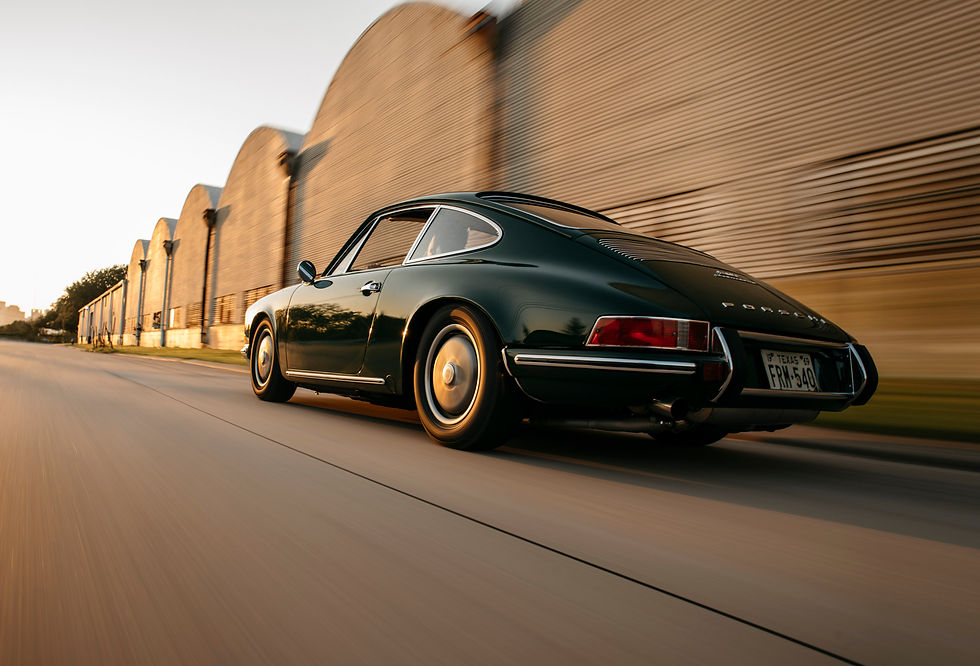
On the Road
From the springy driver’s seat, I grab the big steering wheel and listen closely as Remeljej walks me through the operating procedure: it’s not every day you have to re-learn how to drive a car.
“You can set off in pretty much any gear,” Remeljej says. “Low gear is for hills. D is for neighborhoods – it’s effectively second gear. D3 is for traveling between neighborhoods, and D4 is for highways.”
With my foot on the brake, I move the patinaed gear knob from ‘P’ to ‘D,’ release the pedal, and I’m off. Under throttle, you sense the torque is being modulated by an invisible foot feathering a phantom clutch. You hear that happening, and you feel it beneath you.

The acceleration is a bit jarring — the sound and forward momentum feel non-linear, almost disconnected from your throttle inputs, like the gearbox is playing catch up. In fact, it is. The RPMs spike, and then settle down as the torque converter finds its footing.
But after a few stops and starts, you adapt your driving style to the Sportomatic’s odd rhythm. Give it as much throttle as you want: the gearbox will regulate it and convert it into smooth acceleration.
Once up to speed, it’s fantastic at a cruise. The transmission feels in its element, and it responds to inputs with a satisfying punch of torque. Lift off the gas, and… it’s still going. There’s almost no deceleration while coasting, and no drop in revs — for a split second it feels like this old 911 has cruise control stuck on.

Changing gears as we drive around town is pretty much optional, but as the speed increases, the car is happier in the higher gears. Lift off the throttle, move the shifter to ‘D3,’ and give it a second – maybe even two – before rolling on the throttle. My right foot acclimates to the drop in RPMs and torque, and for some reason it feels more like changing gears on a bicycle than in a manual car.
Let’s not forget that this transmission is bolted into a pretty amazing 1969 911T. The thin-rimmed wheel and refreshed suspension combine to give the driver almost granular precision over the the steering, which is made even more appreciable by not having to think about changing gears.

I love driving a manual 911, but being able to put everything else in the back of your mind so that you can just focus on the steering, or weight transfer, or brake inputs — it’s pretty unique. All longhood 911s are lightweight, but it feels even lighter when you lift away some of the driving duties, and you can just observe without overthinking, and without taking your hands off the wheel.
Ultimately, without a truly connected gearshift experience, the driver is deprived of some of the engagement of an early Porsche 911. But for a car that you could jump in and drive
around town, I see the appeal.
Stay tuned for Part 2 of this story.


Comments